

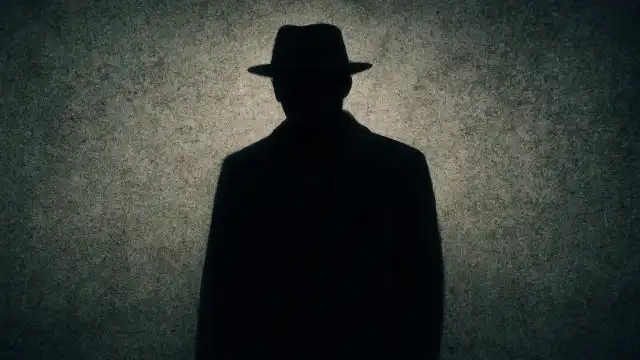
You wake up. You can’t move. Your chest feels heavy, like someone is sitting on it. You try to scream, but your voice is stuck in your throat. Then, you see him. Standing in the corner of your room is a tall, pitch-black shadow. He has no face, no eyes, and he’s wearing a wide-brimmed hat.
He doesn’t attack. He just… watches.
If this sounds familiar, you aren’t crazy. You’ve just met The Hat Man.
This isn’t just a scary story from Reddit. It is a global phenomenon. From teenagers in Ohio to villagers in Guatemala, thousands of people report seeing the exact same figure. But how? How do people who have never met, and live thousands of miles apart, hallucinate the same guy in a trench coat and fedora?
Let’s turn on the lights and look at the science, the myths, and the chilling reality of the Hat Man.
Who or What Is The Hat Man?
The Hat Man is a specific type of “Shadow Person.” While most shadow figures are just shapeless blobs that dash across your peripheral vision, the Hat Man is different. He is distinct. He has a style.
Common descriptions include:

- The Outfit: A long trench coat or cloak.
- The Hat: A wide-brimmed fedora, a top hat, or a gaucho-style cowboy hat.
- The Vibe: Unlike other “sleep demons” that might sit on your chest or choke you, the Hat Man usually stays back. He is an observer. Witnesses often feel an intense, draining sense of dread, but rarely physical pain.
- The Height: He is often described as 6 to 10 feet tall, sometimes looming over the bed.
But why him? Why not a clown, or a wolf, or a guy in a baseball cap?
The Science: Why Your Brain “Invents” Him
Before we call the Ghostbusters, we have to look at biology. Most Hat Man sightings happen during Sleep Paralysis.
The “Glitch” in Your Brain
When you sleep, your body enters REM (Rapid Eye Movement) sleep. To keep you from acting out your dreams and punching your partner, your brain shuts off your muscles. This is called atonia.
Sometimes, your brain wakes up before your body does. You are conscious, but you are paralyzed. This terrifies your brain’s “fear center” (the amygdala). It goes into panic mode and tries to explain why you can’t move.
- Brain: “I can’t move! There must be a predator holding me down!”
- Eyes: “I don’t see anything.”
- Brain: “Make something up! Put a scary figure in the corner!”
Why the Hat?
This is the million-dollar question. Why does our brain choose a fedora?
Psychologists believe it might be a mix of Pareidolia and Archetypes.
- Pareidolia is your brain’s habit of finding faces in random patterns (like seeing a face in the clouds). In a dark room, a pile of clothes on a chair or a coat rack naturally looks like a person.
- Jungian Archetypes: The Swiss psychiatrist Carl Jung believed humans share a “collective unconscious.” The image of a “Dark Watcher” or a mysterious authoritarian figure (often symbolized by a hat/uniform) might be hardwired into our human DNA as a symbol of the unknown.
The “Benadryl Hat Man”: A Modern Mystery
In the last few years, a strange new trend has emerged online. Young people began reporting Hat Man sightings not during sleep, but after taking high doses of Diphenhydramine (DPH), the active ingredient in allergy meds like Benadryl.
This is extremely dangerous and not recommended, but the reports are fascinating.

Users on TikTok and Reddit describe entering a state of delirium where they see shadow people. And guess who the boss is? The Hat Man.
- The Connection: DPH is a deliriant. It messes with the chemical acetylcholine in your brain. This specific chemical disruption seems to reliably produce hallucinations of shadow people and insects.
- The Mystery: Why does a specific drug summon a specific man in a hat? Science says it’s likely how the visual cortex misfires under stress, creating simple, high-contrast upright shapes (shadows) that our brain “dresses up” with details from memory.
He’s Been Here Before: Global Folklore
You might think the Hat Man is a modern internet monster, like Slender Man. You would be wrong. He has been haunting humanity for centuries, just under different names.
1. El Sombrerón (Guatemala & Mexico)
In Central American folklore, there is a legend of El Sombrerón (The Big Hat Man). He is a short figure dressed in black with a massive shiny belt and, you guessed it, a giant hat that covers his face.
- What he does: He doesn’t just watch. He loves to braid the hair of horses and young women. If he likes you, he might throw dirt in your food so you can’t eat, causing you to waste away.
2. The Dark Watchers (California, USA)
For over 300 years, hikers in the Santa Lucia Mountains of California have reported seeing tall, motionless figures standing on the ridges. They wear wide-brimmed hats and capes.
- The Rule: If you look at them, they vanish. Famous American author John Steinbeck even wrote about them. They are nature’s own Hat Men.
3. The Ankou (Celtic/Breton)
In the old folklore of Brittany (France), the personification of death is the Ankou. He is described as a tall, skeletal figure wearing a wide-brimmed hat that hides his face. He drives a cart to collect souls. Seeing him is usually a bad omen.
4. Exu (Afro-Brazilian Beliefs)
In Umbanda and Quimbanda traditions, the spirit Exu is the guardian of the crossroads. He is often depicted as a man of the night, wearing a black suit and a top hat. While Exu is a complex spiritual figure and not a “monster,” the visual parallel of a powerful shadow-man in a top hat is undeniable.
Real Stories from Recent Years
We scoured recent forums and archives from late 2024 and 2025 to find what people are seeing right now. The stories are chillingly consistent.

“He Was Warning Me”
A Reddit user shared a story in mid-2024 about seeing the Hat Man near a family farm. Unlike the usual paralyzed fear, this user felt a strange calm. Two months later, a close family member passed away unexpectedly. The user now believes the Hat Man wasn’t a demon, but a “messenger” or an omen.“He Said Thank You”
In a bizarre account from late 2025, a mother reported her 7-year-old daughter dreaming of a tall shadow in a trench coat and top hat knocking on her door. In the dream, the girl opened the door, and the figure simply walked through her, whispered “Thank you,” and vanished.“The Observer”
Another recent report involved a husband and wife. The wife woke up to see a figure with red eyes and a fedora leaning against the doorframe. She tried to wake her husband, but couldn’t. She felt distinctively that the entity was there for her, not him. It didn’t attack; it just studied her like a scientist looking at a bug in a jar.
How to Stop Seeing Him
If you are one of the unlucky ones who gets visits from the Hat Man, here is what experts and sleep doctors suggest:
- Fix Your Sleep: Sleep paralysis is often triggered by exhaustion, stress, and irregular sleep schedules. Go to bed at the same time every night.
- Don’t Sleep on Your Back: Studies show that sleep paralysis episodes are significantly more common when sleeping in the supine position (on your back). Side sleeping is safer.
- Cut the Antihistamines: If you are taking sleep aids or allergy meds with Diphenhydramine, talk to your doctor. They might be fueling the shadows.
- Wiggle Your Toes: If you wake up frozen and see him, focus all your mental energy on moving just your big toe. This small signal can often break the paralysis and wake your body up fully.
Thoughts
Is the Hat Man a demon traveling between dimensions? Is he a ghost? or is he just a glitch in our tired, stressed-out brains?
The scariest answer might be that he is a little bit of both. He is a monster created by our own biology, but one that we have all agreed to fear together. He is the darkness in the corner of the room that reminds us we are never quite as alone as we think.
Have you ever seen the Man in the Hat? Did he have red eyes, or was he just a shadow? Drop your story in the comments below, if you dare.
Sleep tight. And maybe leave a nightlight on tonight.

