

From the Tinder Swindler to AI Scams: How Romance Fraud Is Evolving – How to Spot & Stop Deepfake Dating Scams
Remember Shimon Hayut? Most folks know him better as Simon Leviev. Back in 2022, Netflix exposed this massive con artist. He posed online as a billionaire diamond mogul. Consequently, victims lost millions to his carefully crafted illusions. Fast forward to late 2025. Georgian police arrested our notorious grifter on an Interpol Red Notice. However, authorities released the man by November after German prosecutors dropped their extradition request due to insufficient evidence. Furthermore, Hayut even launched a cryptocurrency token called TIND earlier that year. Clearly, real world consequences rarely stick.
But here is a terrifying truth. Today’s criminals don’t need private jets. They no longer hire fake bodyguards. Instead, fraudsters use artificial intelligence. Therefore, the “Tinder Swindler” playbook went digital. Suddenly, anyone with an internet connection can build a billionaire persona. Are you ready for the new era of digital deception?
How the Swindler Worked

Let’s break down Leviev’s strategy. First, he utilized extreme love bombing. This guy showered women with extravagant gifts. Naturally, grand gestures build immediate trust. After establishing deep emotional connections, disaster would strike. He faked violent attacks on his security team. Next, he begged victims for emergency funds. Fearing for his life, terrified girlfriends maxed out credit cards.
Essentially, psychological manipulation acted as his core weapon. Financial costs regarding those physical scams remained enormous. Leviev needed cash constantly to maintain false illusions. Thus, he operated a bizarre romantic Ponzi scheme. Paying for one luxurious date required scamming somebody else.
Nowadays, that massive overhead cost vanished entirely.
Why Scammers Don’t Need Jets Anymore
Technology shifted our landscape completely. Generative AI makes creating fake lives incredibly cheap. Consequently, modern con artists scale their operations effortlessly. You aren’t texting one guy inside a hotel room anymore. Usually, victims are talking to sophisticated algorithms.
The ChatGPT Casanova (Text Generation)
Large Language Models changed everything. These systems understand context beautifully. Therefore, they draft emotionally resonant messages in seconds. Want a poem? The bot writes it flawlessly. Need a tragic backstory? Software generates perfect tear jerkers.
In December 2024, the FBI’s Internet Crime Complaint Center (IC3) issued major warnings. Criminals actively exploit AI generated text for social engineering. Furthermore, foreign syndicates use automated translation tools. Gone are those days of poorly spelled phishing emails. Today, grammar remains impeccable. Specifically, industrial “fraud factories” run around the clock messaging campaigns. Algorithms never sleep. They just keep typing.

Deepfake Faces and Synthetic Voices
Seeing is no longer believing. Malicious actors manipulate photos continuously. In fact, they create entirely fictitious social media profiles using synthetic faces. These people do not exist anywhere offline. Yet, their pictures look breathtakingly authentic.

Audio cloning presents another massive threat. Scammers need only brief snippets of recorded audio. Suddenly, they can replicate your loved one’s exact pitch. Have you ever received a frantic midnight call? Imagine hearing your partner crying for help. According to federal agents, criminals embed these vocal clones into crisis scenarios. Naturally, panic overrides logic.
Video deception surged dramatically recently. Throughout 2025, deepfake scam instances skyrocketed by 700 percent. Hackers even conduct live video calls applying real time facial filters. So, that handsome entrepreneur you met online might actually be an international crime syndicate.
The Anatomy of an AI Romance Scam
How does an artificial brain break a human heart? It starts with data harvesting. Fraudsters scrape your public social media pages. They learn your favorite bands, political views, and pet names. Consequently, the chatbot approaches you armed with highly customized icebreakers.
If you recently posted about losing a dog, the scammer expresses profound sympathy. Suddenly, you feel an instant, magical connection. This isn’t serendipity. It is calculated algorithmic targeting.
Naturally, human brains release dopamine during positive romantic interactions. These chemical hits create powerful biological attachments. Surprisingly, scammers program their tools to exploit this exact neurochemistry. They deliver compliments at optimal intervals. Therefore, the victim becomes literally addicted to the conversation.
Simon Leviev’s Modern Counterparts
Unlike Leviev, today’s masterminds hide behind keyboards. Organized crime syndicates run massive compounds in Southeast Asia. Thousands of trafficked workers sit inside crowded cubicles. They supervise AI programs managing millions of dating profiles.
This industrial scale makes the threat exponentially worse. One single operator can romance five hundred victims simultaneously. Indeed, the software translates languages flawlessly. Moreover, it schedules messages to match your local time zone.
Ultimately, you might think you are dating some doctor residing nearby. Instead, reality paints a much darker picture. Actually, victims interact with massive criminal enterprises located continents away. This level of coordination dwarfs traditional con artistry.
2025 Romance Scam Statistics
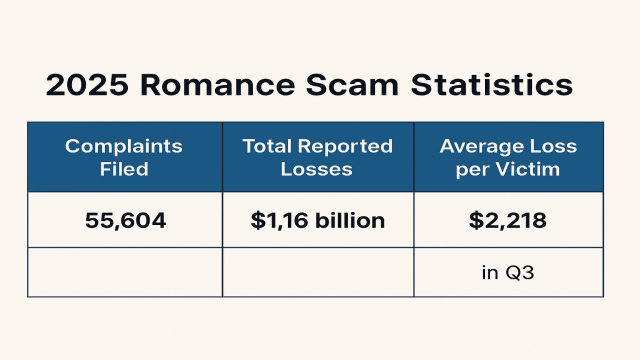
Let’s look at recent financial carnage. The Federal Trade Commission (FTC) released alarming data recently. During the first nine months of 2025, Americans filed 55,604 romance fraud complaints. Shockingly, total reported losses exceeded $1.16 billion.
That equals roughly $2,218 stolen per victim in quarter three alone. Who suffers the most? Older adults bear heavy burdens. In 2024, seniors aged sixty plus lost $2.4 billion to various frauds. However, young folks aren’t safe either.

Sextortion complaints among younger demographics multiplied rapidly. Criminals trick twenty somethings into sending intimate photos, then demand immediate ransom. Moreover, combining love and digital currency created a monster. Experts call this phenomenon “pig butchering.”
The Rise of Pig Butchering
What exactly is this horrific term? Originating in Southeast Asia, the phrase describes fattening targets before slaughter. First, an attacker builds romantic bonds. Next, they casually mention lucrative crypto investments. Sounds harmless, right?
Eventually, your target downloads fraudulent trading apps. Initial small deposits yield massive fake returns. Consequently, victims pour life savings into these platforms. When they try withdrawing funds, money vanishes. The “lover” disappears simultaneously.
According to Chainalysis, AI enabled crypto scams generated $14 billion globally during 2025. These hybrid attacks are incredibly devastating. They destroy both bank accounts and human hearts.
Red Flags in the Era of Automated Romance
How do you spot digital ghosts? Trust your gut, but also look for specific clues. Here is a handy checklist:
- The Perfect Profile: Obviously, nobody is flawless. If their photos look like GQ magazine covers, be cautious. Run reverse image searches immediately.
- Moving Too Fast: Love bombing happens quickly. Do they declare soulmate status within forty eight hours? That signifies massive danger.
- Refusal to Meet: Excuses pile up constantly. They work on remote oil rigs. Perhaps they are deployed overseas. Alternatively, webcams remain mysteriously broken.
- Sudden Financial Crises: Drama follows them everywhere. Suddenly, bank accounts freeze unexpectedly. They desperately need wire transfers or Apple gift cards.
- Pushing Investments: Real dates talk about hobbies, not Bitcoin yields. If cryptocurrency enters chat early, block them completely.
How to Protect Your Heart (and Wallet)
Fortunately, staying safe requires straightforward vigilance. You must adopt a “trust but verify” mindset.
- Demand Live Video: Ask them to perform specific actions. Have the person touch their nose while speaking. Deepfake filters often glitch when hands cross faces.
- Slow Down Relationships: Predators hate patience. If you delay responses, automated bots might break character. Furthermore, human scammers will get frustrated.
- Never Send Money: This rule remains absolute. Do not wire funds to strangers. Avoid purchasing crypto for online matches entirely.
- Set Up Safe Words: Families should establish secret passwords. If someone calls claiming an emergency, ask for the code. Thus, voice cloning schemes fail instantly.
- Report Suspicious Activity: Did someone try scamming you? Contact authorities immediately. File detailed complaints with federal portals like the FBI’s IC3 or the FTC.
What Happens if You Get Scammed?
Panic usually sets in first. Take a deep breath immediately. You are not alone in this fight.
Crucially, cut off all contact instantly. Do not confront the fraudster. Consequently, blocking their profiles prevents further emotional manipulation. Next, document absolutely everything. Take screenshots of text threads, profile pictures, and transaction receipts. Federal agencies need this data to track cybercriminals.
Afterwards, contact your bank or cryptocurrency exchange. Occasionally, rapid reporting can freeze pending wire transfers. Finally, file official reports. The IC3 portal serves as an essential resource. Ultimately, Sharing your story might prevent someone else from losing their life savings.
Breaking the Stigma
Victims often feel intense shame. They hide financial ruin from friends. Consequently, predators operate in the shadows unchecked. We must change this dynamic completely.

Being tricked by military grade psychological manipulation isn’t a personal failure. In fact, these fraud factories employ expert psychologists. Empathy acts as our best defense against isolation.
Wrapping Up the Digital Swindle
Simon Leviev walked out of Georgian prisons recently. His physical cons seem almost quaint now. The modern Tinder Swindler isn’t just one guy wearing designer clothes. Today, it represents server racks humming inside remote warehouses.
Artificial intelligence weaponized human loneliness. By understanding these new tactics, you reclaim your power. Swipe carefully out there. Protect your digital footprint fiercely.
Frequently Asked Questions (FAQ)
How do I expose an AI dating bot using a single text message?
Honestly, bots genuinely hate paradoxes. Therefore, ask your match an illogical question like, “Did you enjoy chewing that glass apple yesterday?” A real human will laugh or express immediate confusion. Conversely, generative algorithms often hallucinate polite agreements to maintain the conversation. Thus, you instantly break their scripted programming.
Why did Simon Leviev escape his extradition in late 2025?
It all boils down to complex jurisdictional loopholes. Specifically, German prosecutors lacked sufficient concrete evidence to uphold their Interpol Red Notice. Consequently, Georgian police officially released him by November. Basically, physical borders still protect traditional con artists. Meanwhile, modern digital thieves simply hide behind unbreakable encryption.
Can real-time deepfake video filters be broken during a FaceTime date?
Yes, you can absolutely shatter the digital illusion. Simply ask your match to pass their hand directly across their nose. Furthermore, have them turn their head rapidly into a side profile. Usually, synthetic overlays struggle significantly with rendering complex depth overlapping. As a result, the fake face glitches, revealing the true caller underneath.
Are banks refunding victims of 2026 crypto “pig butchering” scams?
Unfortunately, the brutal reality is almost always no. Because victims technically authorize those initial wire transfers themselves, financial institutions classify them as voluntary authorized transactions. However, federal cyber task forces are currently freezing rogue exchange wallets faster than before. Still, recovering those lost funds remains incredibly rare.
Why do cyber experts strongly warn against confronting a romance scammer?
Calling them out creates immediate, severe danger. Rather than apologizing, cornered international fraud rings often pivot directly into aggressive sextortion. Essentially, they violently weaponize whatever private photos or secrets you previously shared. Therefore, quietly blocking their accounts and reporting the profile remains your absolute safest exit strategy.
Have you encountered a suspicious profile lately? Drop a comment below and share this article with your friends to keep them safe from the next generation of digital swindlers!
Sources help:
- https://en.wikipedia.org/wiki/Simon_Leviev
- https://oc-media.org/israeli-tinder-swindler-arrested-in-batumi/
- https://www.ic3.gov/PSA/2024/PSA241203
- https://www.ftc.gov/news-events/news/press-releases/2025/12/ftc-issues-annual-report-congress-agencys-actions-protect-older-adults
- https://www.ic3.gov/PSA/2023/psa230605

