

The Secret Imprisonment of Blanche Monnier: A True Crime History
- The Crime: Blanche Monnier, a beautiful French socialite, vanished in 1876. Her aristocratic mother and brother locked her in a pitch-black attic room for a quarter of a century.
- The Motive: She fell in love with a penniless, older lawyer. Her status-conscious mother refused to allow the marriage and chose imprisonment over social disgrace.
- The Rescue: An anonymous letter sent to the authorities in 1901 led police to a horrific scene. Blanche was found emaciated, weighing just 55 pounds, living amidst bugs and waste.
- The Legal Twist: The mother died 15 days after her arrest. The brother escaped punishment on a legal loophole because French law at the time lacked a clear “duty to rescue” statute.
Sunlit street in 19th-century France. You pass a grand mansion owned by a highly respected, upper-class family. The matriarch is known for her widespread charitable work. Everyone looks up to them. Yet, right above your head, behind a bricked-up window in the attic, a young woman is living in absolute filth, surrounded by rodents, having not seen a single ray of sunlight for more than two decades.
This isn’t a gothic horror novel. It is the terrifying reality of Blanche Monnier. Her ordeal remains one of the most chilling cases of domestic captive abuse in human history.
The Golden Cage of Poitiers
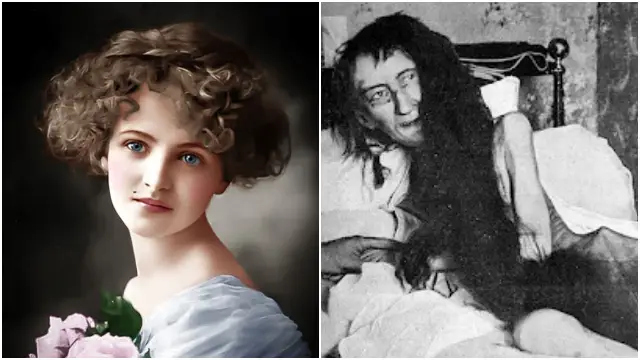
Born on March 1, 1849, in Poitiers, France, Blanche Monnier seemed to have won the genetic and social lottery. She belonged to an old, aristocratic family. Her father, Charles-Émile Monnier, was the former dean of the local university’s faculty of letters. Her mother, Louise Monnier, ruled their social circle with an iron fist wrapped in velvet.
Blanche was widely celebrated for her striking physical appearance, deep dark eyes, and thick, luxurious hair. Suitors practically lined up at the front door. Her life looked like a predictable, comfortable map of high-society events, gala dinners, and an eventual marriage to a wealthy nobleman.
What went wrong? Blanche possessed a fierce streak of independence.
By the time she reached her mid-20s, she still hadn’t picked a husband from her mother’s approved list. Then, around 1876, she made a choice that shattered her family’s pristine image. She fell madly in love with an older lawyer who lived nearby. He was a kind man, but he had two fatal flaws in the eyes of Madame Monnier: he was broke, and he was a Protestant. The Monniers were staunchly Catholic, fiercely royalist, and deeply obsessed with their public standing.
Madame Monnier delivered an ultimatum. Blanche must break off the romance immediately.
Blanche dug her heels in. She refused to trade true love for a title or a fat bank account. Who could have guessed how far a mother would go to prevent a social scandal?
The Disappearance That Nobody Questioned

One evening in 1876, 27-year-old Blanche simply vanished from the face of the earth.
Did she run away? Did she elope with her penniless lover? Her family had a ready-made story for anyone who asked. Madame Monnier and Blanche’s older brother, Marcel, wept openly in public. They told neighbors and friends that Blanche had been sent away to a strict boarding school in Scotland to finish her education. Later, the narrative shifted. They claimed she had moved permanently to a remote part of Europe.

Eventually, the family dropped a final, heartbreaking update: Blanche had passed away. The community offered their deepest condolences. The Monniers put on their black mourning clothes and went right back to their high-society lives.
Her lover spent years searching for her, completely heartbroken. He died in 1885 without ever learning what happened to the woman he wanted to marry.
The terrifying truth was right inside the house. Angered by her daughter’s refusal to obey, Louise Monnier had dragged Blanche up to the highest point of their mansion. She shoved her into a tiny, windowless attic room and padlocked the heavy wooden door.
The Anonymous Letter That Changed Everything
For 25 years, the world moved on. The 19th century turned into the 20th century. Empires fell, technology advanced, and cars began appearing on European streets. Meanwhile, Blanche remained trapped in a static, pitch-black nightmare.
Everything unravelled on May 23, 1901. The Attorney General of Paris received a strange, unsigned letter. The text was short, frantic, and pointed directly at the immaculate Monnier estate.
“Monsieur Attorney General: I have the honor to inform you of an exceptionally serious occurrence. I speak of a spinster who is locked up in Madame Monnier’s house, half-starved and living on a putrid litter for the past twenty-five years — in a word, in her own filth.”
The authorities were baffled. The Monniers were local royalty. Marcel Monnier was a respected former public official and a doctor of law. Was this a cruel prank or a malicious attempt to smear an honorable family’s name?
Fortunately, the prosecutor refused to ignore the tip. He dispatched Police Commissioner Bucheton and a small team of officers to investigate the Monnier residence.
When the police arrived, Madame Monnier tried to turn them away at the door. The officers insisted on searching the property. As they climbed the stairs to the second floor and neared the attic, a foul, suffocating odor began to fill the hallway. They found a heavy door wrapped in chains and secured with a massive padlock.
The police smashed the lock and forced their way inside.
Inside the Attic
The officers were hit by an overpowering wave of stench that made them gasp for air. The room was completely dark. Thick, heavy curtains had been nailed to the window frames, and the wooden shutters were sealed tight with rust and grime. One officer rushed over to pry the windows open, breaking the old chains.

As a bright beam of May sunlight cut through the darkness for the first time in 9,131 days, the police gasped at what they saw.
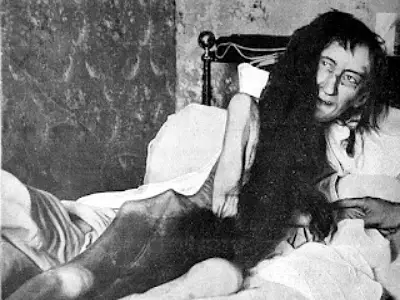
Lying naked on a rotting straw mattress was a skeletal figure. It was Blanche Monnier. At 52 years old, she weighed a meager 55 pounds. Her body was so frail that she looked like a living anatomy doll. Long, matted hair cascaded all the way down to her ankles. Her fingernails had grown into thick, curved claws.
The floor was a thick, hardened crust of human waste, rotting meat, fish bones, and moldy bread scraps. Bugs and spiders were crawling across the bed and over her skin. Huge rats scampered into the corners of the room, startled by the sudden influx of light.
Blanche was so terrified of the sun that she wrapped her filthy sheets over her head. She had forgotten how to speak in full sentences, uttering only high-pitched screeches of terror.
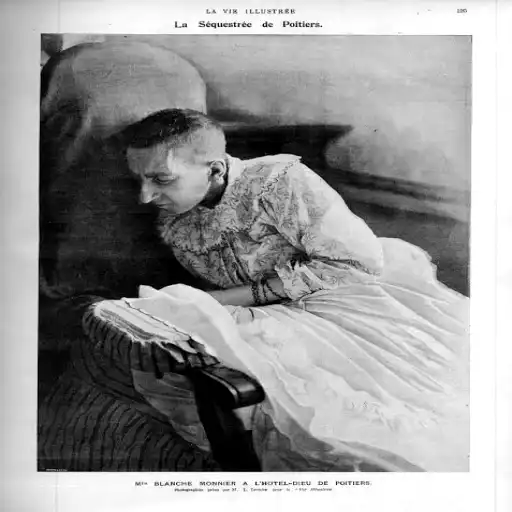
The police wrapped her in clean blankets and rushed her to the nearby Hôtel-Dieu hospital. When the doctors placed her in a warm bath and washed away decades of neglect, Blanche reportedly closed her eyes and whispered how wonderful it felt to feel clean again.
The Trial and the Loophole That Shocked France
The news hit the French public like an earthquake. Angry mobs gathered outside the Monnier mansion, shouting for justice. How could a mother do this to her own flesh and blood?
Louise and Marcel Monnier were arrested immediately. The 75-year-old mother never faced a judge, though. The shock of being caught, combined with a sudden onset of heart failure, killed her just 15 days after her arrest.
That left Marcel Monnier to stand trial alone for complicity in acts of violence.
The trial began on October 7, 1901. The courtroom was packed to the brim. Marcel’s defense strategy was both brilliant and deeply unsettling. He didn’t deny that Blanche lived in a horrific state. Instead, he argued that she was profoundly mentally ill and suffered from severe anorexia nervosa and coprophilia (an abnormal fascination with feces).
Marcel claimed that Blanche had chosen to stay in that room. He testified that the door was not always locked and that she could have walked out whenever she wanted. Servants testified that Blanche would have violent, screaming episodes, which made them terrified to enter the room without Madame Monnier’s direct supervision.
The initial court found Marcel guilty and sentenced him to 15 months in prison. He immediately appealed the verdict, and this is where the historical facts of the case take a deeply frustrating turn.

In 1901, the French Penal Code did not contain a law against the “failure to rescue” an endangered person. That specific legal concept — known today in European law as duty to rescue — simply didn’t exist back then. Since Marcel had never personally laid a hand on Blanche, used physical violence, or directly stopped her from leaving, the appellate court ruled that he hadn’t committed a legally defined crime.
Marcel Monnier was acquitted and walked out of the courtroom a free man, though he had to flee Poitiers to escape the furious locals who wanted to tear him apart.
The Tragic Aftermath
Blanche survived her rescue, but she never truly recovered. A quarter-century of isolation, darkness, and psychological terror had broken her mind beyond repair.
Doctors officially diagnosed her with several severe conditions, including schizophrenia. She was moved to the Marceline Hospice, a peaceful psychiatric hospital in Blois, France. There, surrounded by gardens and under the gentle care of nurses, she lived out the remainder of her life.
She never regained enough mental clarity to explain why she stayed silent for so long, or what she thought about during those long, dark decades. Blanche Monnier passed away on October 13, 1913, at the age of 64. Her death occurred just a year before World War I would tear through Europe, ending the era she had been pulled away from so brutally.
Why Didn’t Anyone Stop It?
When you look back at this historical mystery, one big question haunts you: How did a secret like this keep for 25 years?
The house wasn’t empty. Over two decades, multiple maids, cooks, and service staff worked inside the Monnier estate. A local carpenter frequently came to the house to fix furniture and doors. Everyone knew Blanche was upstairs.
The answer lies in the terrifying power of 19th-century societal dynamics:
- Extreme Class Protection: In that era, an aristocratic family’s reputation was everything. The community preferred to mind their own business rather than question a wealthy woman who gave heavy donations to local churches.
- Fear of the Matriarch: Employees testified that Madame Monnier was an absolute tyrant. They feared losing their livelihoods or being blacklisted from work if they went to the police.
- The Stigma of Mental Illness: In the 1800s, families went to extreme lengths to hide relatives who suffered from mental health crises or behavioral issues, viewing them as a curse or a source of deep shame.
Blanche’s story serves as a permanent, tragic reminder of what happens when a society values keeping up appearances over protecting human life. Her name, la Séquestrée de Poitiers, lives on in legal textbooks and true crime history as a heartbreaking symbol of innocence crushed by cruel family pride.
What Do You Think?
The story of Blanche Monnier leaves us with a lot of heavy questions about human nature and societal pressure. Do you think the brother deserved to walk free on a legal technicality? How do you think a whole neighborhood managed to stay blind to the horror for so long?
Let’s discuss it in the comments below! If you found this historical deep-dive gripping, hit the share button to pass it along to your fellow true crime enthusiasts.

