

The History of Ghost Hunting: From Victorian Séances to Modern Paranormal Investigation
Have you ever sat in a pitch-black room, staring at a green-glowing screen, waiting for a static-filled voice recorder to whisper your name? If you have, you are part of a massive, centuries-old club. Ghost hunting did not start with cable television or viral YouTube channels. Long before investigators carried thermal cameras into crumbling mental asylums, our ancestors were trying to pierce the veil between life and death.
Our relationship with the spirit world is ancient, but the way we hunt ghosts has undergone a wild evolution. How did we get from holding hands around candlelit tables to waving high-tech electromagnetic sensors in empty hallways? Let’s take a trip through time to see how ghost hunting went from a parlor game for elites to a gadget-fueled obsession.
Need to know
- Ancient Roots: The earliest recorded ghost hunt goes back to the first century CE.
- The Victorian Craze: The birth of Spiritualism in 1848 turned séances and table-tipping into a massive cultural phenomenon.
- Early Tech: 19th-century advancements like photography, the telegraph, and the radio made people believe tech could bridge the gap to the afterlife.
- Scientific Skepticism: Organizations like the Society for Psychical Research stepped in to debunk clever frauds and study anomalies with rigid methods.
- Modern Gear: Today’s investigators rely on tools like EMF meters and thermal cameras, though science remains highly skeptical.
Pre-Victorian Ghostly Encounters
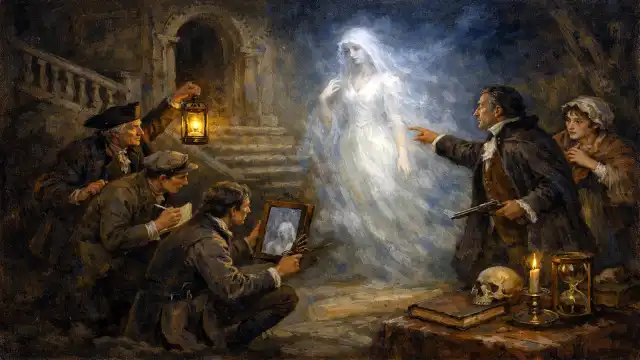
Long before the invention of electricity, humans were already trying to figure out if spirits walked among them. But early ghost hunting was not about capturing data. It was about survival, religion, and curiosity.
If you want to find the first written account of a ghost hunt, you have to go back to ancient Rome. Pliny the Younger, a famous Roman writer, penned a letter in the first century CE describing a haunted house in Athens. A philosopher named Athenodorus bought the cheap, abandoned villa despite rumors of a ghost rattling chains. Instead of fleeing, the philosopher sat up at night waiting for the spirit. When the specter appeared, Athenodorus followed it into the garden, where it vanished. The next day, townspeople dug up the spot and found a skeleton bound in chains. Once the bones were buried properly, the haunting stopped.
During the Middle Ages, ghost hunting shifted. Catholic theology taught that souls trapped in Purgatory might return to ask the living for prayers. Conversely, protestants often viewed apparitions as demonic tricks designed to lead people astray. If you claimed to see a ghost back then, you did not call an investigator. You called a priest to perform an exorcism. Exploring the supernatural on your own was a fast track to being accused of heresy or witchcraft.
The Victorian Boom: Table-Turning and Ectoplasm
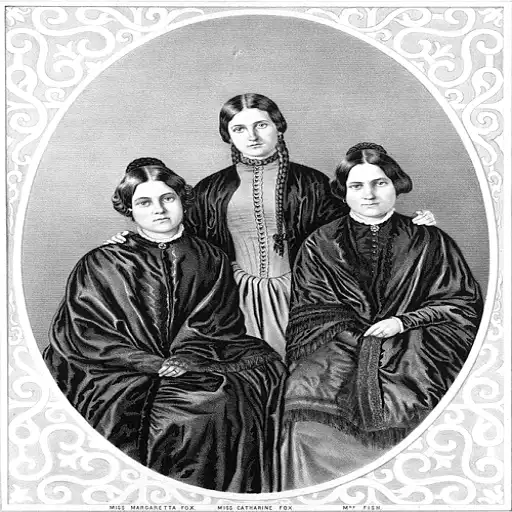
Everything changed on April 1, 1848. In a small, drafty cabin in Hydesville, New York, two young sisters named Kate and Margaret Fox claimed they could communicate with a mysterious spirit haunting their home. They called this entity “Mr. Splitfoot” and established a system of knocks or “raps” to ask questions.
News of these talking raps spread like wildfire across America and Europe. This singular event birthed Spiritualism, a religious movement built on the belief that the dead could, and wanted to, talk to the living.
Suddenly, talking to ghosts was the hottest trend in town. Victorian drawing rooms were transformed into dark séance chambers. But how exactly did people “hunt” ghosts in the 1800s? They did not run around with cameras. Instead, they gathered around heavy wooden tables.
       [ THE VICTORIAN SÉANCE ]
                  │
        ┌─────────┴─────────┐
        ▼                   ▼
  [Table Tipping]    [Spiritual Mediums]
  Attendees placed    A person acting as
  hands on tables     a bridge to let
  to feel vibration   spirits speak or
  and rhythmic taps.  write messages.
Table tipping, also known as table turning, became an absolute obsession in the 1850s. A group of people would sit in a circle, place their hands flat on a table, and wait for a spirit to shake, rattle, or tilt the furniture. If the table tipped once for “yes” and twice for “no,” they had their answers.

Why did this explode right alongside the Industrial Revolution?
Interestingly, the rise of Spiritualism mirrored a massive leap in human technology. Steamships, railways, and the electric telegraph were changing the world. The telegraph, in particular, allowed humans to send invisible messages across massive distances instantly. To the Victorian mind, if we could send a message across the Atlantic via a copper wire, why couldn’t we use natural, unseen energies to chat with the dead?
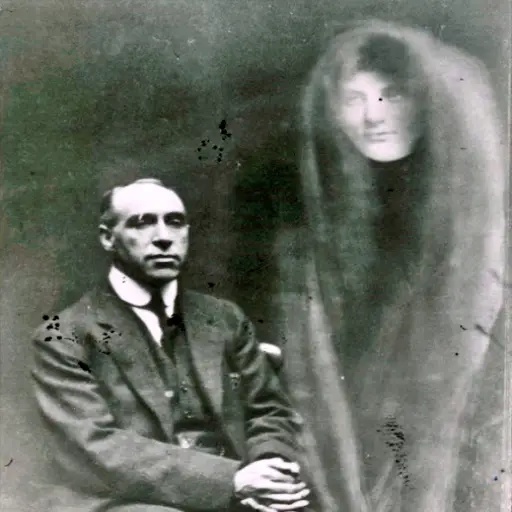
This mindset paved the way for spirit photography. A photographer named William Mumler accidentally discovered double exposure in the 1860s and quickly realized he could make a fortune. He began offering portraits where grieving customers sat next to the faint, blurry “spirits” of their lost loved ones.
The Rise of Psychic Research
As the Spiritualist movement grew, so did the number of tricksters. Fake mediums used hidden pulleys, glowing gauze (masquerading as ghostly “ectoplasm”), and toe-cracking tricks to scam grieving families. This rampant fraud caught the attention of serious scientists who wanted to separate fact from fiction.
In 1882, a group of scholars in London founded the Society for Psychical Research (SPR). This was the world’s first major organization dedicated to studying paranormal claims using systematic, academic methods. They did not just take a medium’s word for it. Instead, they brought in magicians, scientists, and psychologists to examine the phenomena under controlled conditions.
Harry Price: The Original Gadget Guy
If there is one person who bridged the gap between Victorian mysticism and modern technology, it is Harry Price. Born in 1881, Price was a brilliant showman, parapsychologist, and amateur magician. He realized that to catch a fake medium, you had to understand how stage magic worked.
                     [HARRY PRICE'S METHODS]
                                │
             ┌──────────────────┴──────────────────┐
             ▼                                     ▼
     [Exposing Frauds]                    [Instrumental Investigation]
     Used stage magic secrets             Developed the first "mobile lab"
     to catch mediums using               with chemical tests, sealed doors,
     pre-exposed film plates.             and physical measuring tools.
Price became famous for exposing famous frauds. In 1922, he caught spirit photographer William Hope red-handed by secretly marking the glass camera plates beforehand. When Hope’s “ghost” photos appeared on unmarked plates, Price knew they had been swapped out in the dark.
But Price did not just debunk. He wanted to find real proof.
His most famous case was the investigation of Borley Rectory, a Victorian home in Essex dubbed “the most haunted house in England”. Price leased the house for a year, moving in a massive trunk of gear. This setup included:
- Thermometers to track sudden temperature drops (what we now call “cold spots”).
- Powder and flour to sprinkle on floors to catch ghostly footprints.
- Steel tape measures to check if walls were physically moving.
- Electrically wired buttons attached to bells to see if doors or windows were opened by unseen forces.
Price essentially wrote the playbook for the modern paranormal investigator. He showed the world that you could study a haunted house with tools instead of séances.

The Mid-Century Transition: Tape Recorders and EVPs
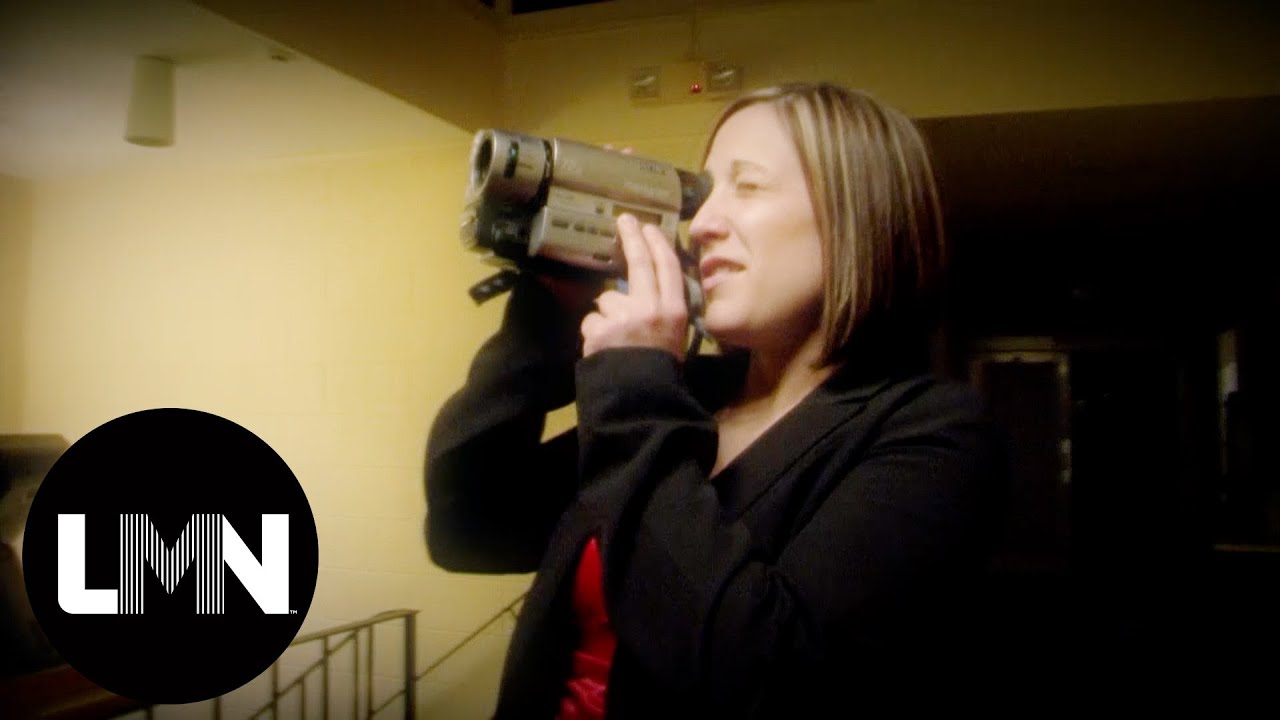
By the mid-20th century, ghost hunting moved away from haunted houses and into the laboratory. The focus shifted from physical apparitions to audio and electromagnetic waves.
In the late 1950s, a Swedish film producer named Friedrich Jürgenson went into the woods to record bird songs. When he played the tapes back, he did not just hear birds. He heard a faint, static-heavy voice that sounded like his deceased father speaking to him.
This discovery launched the study of Electronic Voice Phenomena (EVP).
A Latvian psychologist named Konstantin Raudive took Jürgenson’s work and ran with it. He recorded thousands of hours of static in completely silent rooms. Raudive claimed that if you listened closely to the tape hiss, you could hear the dead communicating in short, rapid bursts of multi-lingual speech.
What made EVP so popular was its accessibility. Anyone with a reel-to-reel tape recorder or a cheap cassette deck could try it at home. Ghost hunting was no longer a hobby reserved for wealthy British aristocrats with private laboratories. It was becoming a suburban pastime.
At the same time, husband-and-wife team Ed and Lorraine Warren were popularizing paranormal investigation in America. Founded in 1952, their New England Society for Psychic Research investigated highly publicized cases like the Amityville Horror. While Lorraine claimed to be a clairvoyant medium, Ed focused on gathering physical evidence, using reel-to-reel audio tapes and cameras to document their cases.
The Digital Revolution: Ghost Hunting on Television
If you grew up in the early 2000s, you likely remember the exact moment ghost hunting exploded into pop culture. In 2004, the Syfy channel premiered Ghost Hunters, a reality show following a group of blue-collar plumbers who investigated haunted spots at night.
This show changed the game. It threw out the dusty, academic vibe of old psychical research and replaced it with high-octane, tech-heavy thrill rides.
Suddenly, a ghost hunter’s toolkit looked like something out of a science fiction movie. Let’s look at the primary tools used in modern investigations and how they supposedly work.
| Tool Name | What It Does | Paranormal Theory | Scientific Reality |
|---|---|---|---|
| EMF Meter | Measures electromagnetic fields. | Spirits manipulate local energy grids to manifest. | Picks up faulty wiring, old appliances, and cell phones. |
| Thermal Camera | Detects heat signatures. | Captures “cold spots” or energy drains left by ghosts. | Measures drafts, air currents, or reflection off shiny walls. |
| Spirit Box | Sweeps rapidly through AM/FM radio frequencies. | Spirits can manipulate white noise to speak in real-time. | A phenomenon called audio pareidolia, where the brain pieces together random syllables into words. |
| REM Pod | Creates its own static EM field. | Sounds an alarm if a spirit gets close and breaks the field. | Easily triggered by radio interference, walkie-talkies, or shifting air. |
Do these gadgets actually prove ghosts exist? Unfortunately, no.
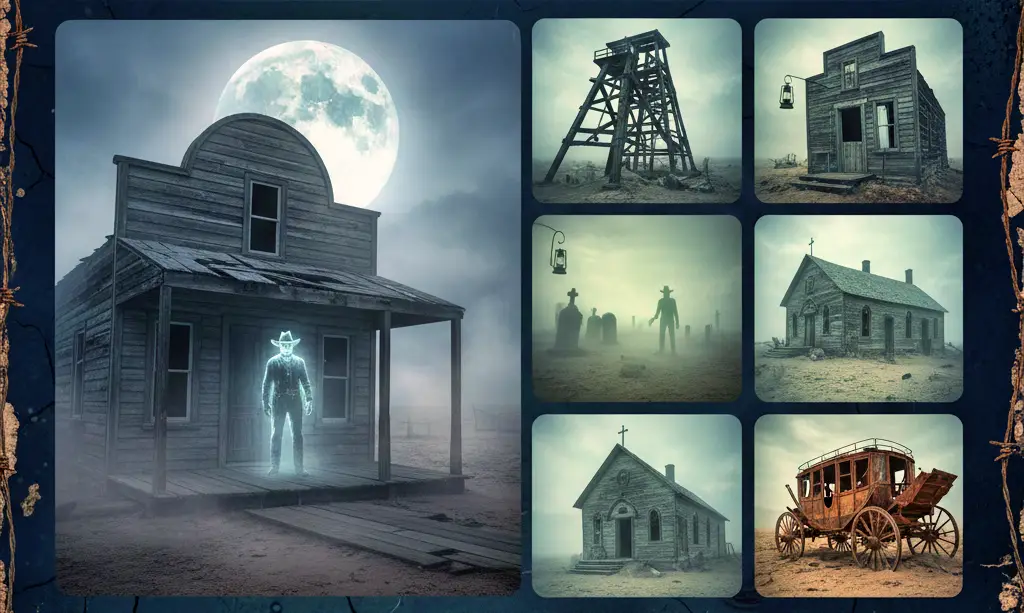
The vast majority of scientists and educators consider modern ghost hunting to be a pseudoscience. While these electronic devices are real pieces of scientific equipment, they are rarely used with proper scientific controls on TV. For instance, an EMF meter spiking in an old, abandoned house is far more likely to be caused by unshielded wiring or a nearby power line than a Victorian phantom.
The Psychology of the Hunt: Why We Want to Believe
If science has debunked so much of the field, why do we keep looking? Why do we still get a thrill when a flashlight turns on by itself on command?
The answer lies in our own brains. Human psychology is hardwired to find patterns in chaos.
The Idiomotor Effect
Ever wonder how a Ouija board actually moves? It feels like an invisible force is dragging your fingers across the planchette. But it is actually a well-documented psychological phenomenon called the idiomotor effect. This is when your body makes tiny, unconscious muscle movements based on what you expect or want to happen. You are moving the plastic piece yourself, but your brain is completely unaware of it.
Pareidolia and Apophenia
Have you ever looked at a pattern in a wooden door and sworn you saw a face staring back? That is pareidolia. Our ancestors survived by quickly spotting predators in the brush, so our brains became incredibly good at recognizing faces, even where none exist. When a ghost hunter takes a photo in a dusty attic and points out a floating “orb” or a “shadow figure” in the rafters, it is almost always pareidolia at play.
               [THE COGNITIVE BIAS LOOP]
                           │
             ┌─────────────┴─────────────┐
             ▼                           ▼
      [Pareidolia]                 [Apophenia]
      Seeing familiar shapes       Finding meaningful connections
      (like faces) in random       in random, unrelated events
      patterns of dust or light.   (like a noise and a cold draft).
Infrasound: The “Fear Frequency”
Sometimes, a haunting is literally a sound you cannot hear. Infrasound refers to low-frequency vibrations below 20 Hz—the limit of human hearing. Even though you cannot hear it, your body can feel it. Studies have shown that exposure to infrasound can cause feelings of dread, shivering, hyperventilation, and even visual distortions (by vibrating the human eyeball). Old, drafty houses with wind howling through specific pipes are perfect breeding grounds for this natural, spooky phenomenon.
History’s Haunting Loop
When you look closely at the history of ghost hunting, you realize we have been running in a giant circle for two hundred years.
The Victorians used the telegraph and photography to seek comfort from the unknown.
Mid-century researchers used tape recorders.
Modern investigators use thermal cameras and smart apps.
Every time humanity invents a new piece of technology, we immediately point it into the dark, hoping to catch a glimpse of whatever lies beyond. We want to believe that there is something more after our physical bodies give out. Whether you are a hardened skeptic or a true believer, that deep desire to connect with the unknown is what makes us human.
What’s Your Take?
Are you a skeptic who believes in logical explanations, or have you captured an unexplainable EVP on your phone? What piece of ghost-hunting gear do you think is the most credible? Let us know in the comments below!

