

1667 Round Top Road in Harrisville, Rhode Island is a 1700s farmhouse with a documented chain of owners, recorded deaths, and decades of alleged paranormal activity that later inspired The Conjuring film franchise. In the 2000s and 2010s it shifted from quiet private home to high-profile ghost-hunting hotspot, complete with lawsuits, media tours, and a $1.5 million sale tied directly to its haunted reputation.

Quick facts for context
Before diving into the weird stuff, it helps to lock in the basic facts.
- Location: Rural farmhouse in Harrisville, in the town of Burrillville, Rhode Island; the property is widely publicized as 1667/1677 Round Top Road because some media and listing records use slightly different house numbers.
- Construction: The core farmhouse dates to around 1736 and was originally known as the Dexter Richardson House, later the Arnold Estate, long before anyone called it The Conjuring House.
- Original size: The farm once covered roughly 200 acres, though today it sits on about 8.5 acres of land.
- Early names: Over time it has been referred to as the Richardson House, the Old Arnold Estate, Old Brook Farm, and only recently the Conjuring House.
- Perron family era: Roger and Carolyn Perron and their five daughters moved in around 1970–1971 and stayed about ten years, reporting hauntings that became the backbone of Andrea Perron’s memoirs and the 2013 movie.
- Modern owners: After several changes in ownership, paranormal investigators Cory and Jennifer Heinzen bought the house in 2019, then sold it in 2022 to Boston developer Jacqueline Nuñez for about $1.5 million.
- Current use: Instead of being a quiet family home, it now runs as a paranormal-tour and investigation business with overnight stays, livestreams, and events built around its haunted branding.
These facts give you a solid skeleton; now the history and hauntings fill in the muscle and scars.

Colonial roots and real tragedies
Long before Hollywood turned it into a franchise anchor, the property was just a working New England farm owned by generations of the same extended family. The earliest known version of the house is linked to the Richardson family, and by the 1800s it was widely known as the Arnold Estate, home base for a line of Arnolds who farmed the surrounding land.
Town records and a former local ledger called the Black Book of Burrillville show that the farm’s history includes several grim incidents. According to that research, the wider property was associated over the years with multiple suicides, accidental deaths, and at least one violent crime involving members of the extended family.

Documented events include:
- Two people who died by hanging on or connected to the property.
- One suicide by poison.
- The r#pe and m$rder of 11‑year‑old Prudence Arnold by a farmhand.
- Two drownings.
- Several men who reportedly froze to death in the surrounding area.
Those deaths happened over a long period, not as a single “curse,” but they fed later local talk that the land itself was somehow unlucky. When the Perrons started digging into the house’s past in the 1970s, those stories became part of how they interpreted what they were experiencing.

Bathsheba Sherman: legend vs records
If you only know the movie, Bathsheba Sherman is the main villain hanging over the story. In real life, she was a 19th‑century woman from the area whose reputation as a “witch” grew mostly from rumor, not from any official trial or execution.
Historical research shows Bathsheba Thayer was born in Rhode Island in 1812 and later married farmer Judson Sherman in neighboring Connecticut in 1844. Census and family records indicate she lived a fairly typical rural life for the time, raising at least one documented son and possibly other children who died young, which sadly was common in that era.
Local legend claimed she killed an infant with a sharp tool during a ritual and was accused of witchcraft, but researchers have not found court records showing any formal charge, trial, or execution. She died in the 1880s and was buried in a nearby cemetery, again without any official note branding her a witch.
So how did she get tied to the house? Decades later, when paranormal investigators Ed and Lorraine Warren visited the Perron farmhouse, they heard both about Bathsheba’s grave and about an unexplained leg injury Carolyn Perron once suffered that looked like a puncture wound. Lorraine connected that story with the old rumor about Bathsheba harming a baby with a needle, and from then on the Warrens labeled the main “entity” in the house as Bathsheba, even though Bathsheba herself actually lived on a neighboring farm, not in the Perron house.
In short, the Bathsheba element blends real people, unproven accusations, and later paranormal interpretation perfect for a horror movie, but more complicated as documented history.
The Perron family haunting years
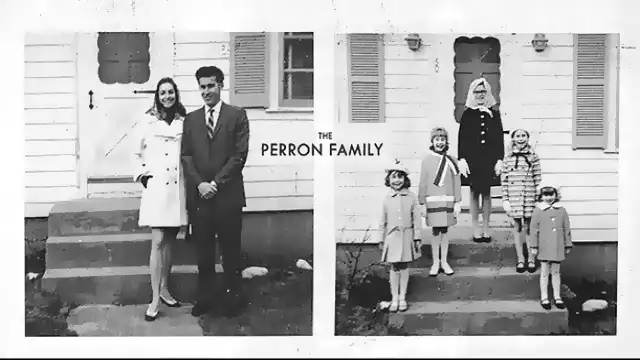
When the Perrons bought the then‑Arnold Estate in winter 1970, they were just looking for land and space for five kids, not a horror plot. They moved into a 14‑room farmhouse on what was still a much larger property than today, and they quickly began reporting strange experiences, especially Carolyn and several of the daughters.
Different accounts describe different phenomena, but the most commonly repeated claims include:
- Apparitions of men, women, and children in period clothing.
- Doors opening or closing, knocks and footsteps, and objects moving on their own.
- Strong odors described as rotting or sulfuric that would appear and vanish.
Oldest daughter Andrea Perron later wrote a three‑volume memoir, House of Darkness, House of Light, describing a decade of escalating activity, from relatively mild encounters to events she frames as violent attacks on her mother. Not every family member agrees on every detail, but most acknowledge something strange was going on, even if they interpret it differently now.
Sometime in the early 1970s, the Warrens became involved after hearing about the case through other paranormal researchers. Their visit included at least one séance or ritual intended to communicate with whatever was in the house, and Andrea has described watching her mother appear to be taken over and thrown or lifted in ways that terrified the family.
The film shows a dramatic exorcism led by Ed Warren, but available accounts suggest the real event was closer to a séance gone wrong than a formal church‑sanctioned exorcism. After roughly ten years, the Perrons left the farmhouse around 1980, with Carolyn reportedly convinced that staying another winter would break her health completely.
From quiet farmhouse to paranormal business
After the Perrons moved out, new owners took over, and for a while the house mostly slipped off the public radar. By the late 1980s, it was owned by Norma Sutcliffe and her husband Gerry, who lived there for years and later became vocal critics of some of the more extreme claims tied to the property.
Sutcliffe has acknowledged experiencing occasional odd events noises, vibrations, doors moving but she challenged both Andrea Perron and the movie’s version of events, arguing that the film’s huge success triggered vandalism, trespassing, and fear that did real‑world damage to her life. She and her husband even filed a lawsuit connected to the film, not over ghosts but over the wave of unwanted attention that fans brought to their doorstep.
The next big shift came in June 2019 when paranormal investigators Cory and Jennifer Heinzen purchased the home for about $439,000. They leaned fully into the haunted reputation, running overnight investigations, tours, and events, and publicly discussing experiences such as disembodied voices, footsteps, and what they believed were intelligent responses through spirit‑box sessions.
By 2021 the Heinzens had put the house on the market with an asking price around $1.2 million, explicitly marketing it as The Conjuring House and emphasizing its paranormal draw. In May 2022, they sold it to Boston‑based developer and self‑described paranormal enthusiast Jacqueline Nuñez for roughly $1.5 million, after interviewing potential buyers to make sure whoever purchased it would keep the ghost‑tour business going and avoid living there full‑time.
Nuñez has continued and expanded the investigation/tour model, hosting structured overnight visits, public events, and livestreams for fans who want hands‑on paranormal experiences at the site. Coverage in 2025 also noted that talk of potential auctions or changes in how the property is managed has sparked fresh debate, proving the “Conjuring House” brand is still commercially and culturally powerful more than a decade after the movie released.
So is it really haunted? That depends on how much weight you give to personal testimony and paranormal investigation methods versus skeptical explanations and the clear financial incentive to keep the legend alive. Either way, the paper trail of ownership, lawsuits, deaths linked in town records, and modern tourism is very real, making 1667 Round Top Road one of the most documented “haunted houses” in the United States.

