
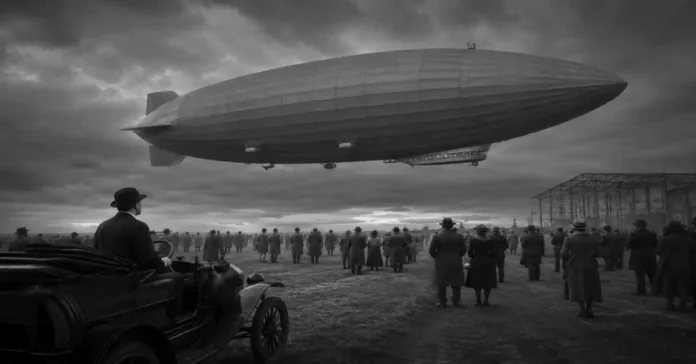
On a quiet Sunday morning in August 1942, two Navy pilots lifted off from San Francisco Bay to search the Pacific waters for enemy submarines. Hours later, their airship drifted back to shore and crashed into a suburban street with both engines running, the cabin door wide open, and nobody inside. The bizarre disappearance of Lieutenant Ernest Cody and Ensign Charles Adams turned the airship L-8 into one of the most baffling cold cases in aviation history.
The routine patrol that drifted into legend
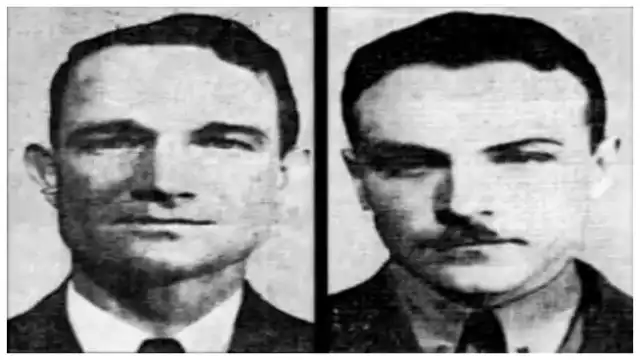
Eight months after Pearl Harbor, the Pacific Coast lived on high alert. Japanese submarines had already shelled an oil refinery near Santa Barbara and torpedoed merchant vessels along the coastline. San Francisco was terrified of another surprise attack.
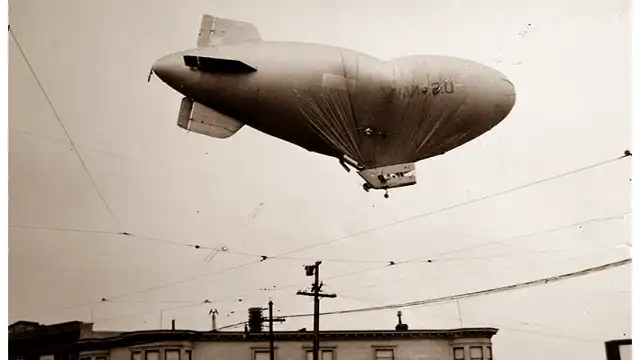
To patrol the shipping lanes, the US Navy relied on L-class blimps. These non-rigid airships were agile, quiet, and capable of hovering low over the water for hours. Airship Patrol Squadron 32 (ZP-32) operated out of Treasure Island, tasked with escorting convoys and hunting underwater threats.
The crew scheduled for the August 16 patrol represented top-tier naval experience:
- Lieutenant Ernest DeWitt Cody (Age 27): A 1938 Naval Academy graduate with sharp instincts. Earlier that year, Cody had personally flown an airship to deliver crucial aircraft parts directly onto the deck of the aircraft carrier USS Hornet before the famous Doolittle Raid.
- Ensign Charles Ellis Adams (Age 35): An airship veteran of two decades. Adams had survived the fiery crash of the massive dirigible USS Macon in 1935 and was making his first official patrol flight as a newly commissioned officer.
A third crew member, Aviation Machinist’s Mate James Riley Hill, was slated to join the flight. Heavy morning moisture weighed down the envelope, so Cody ordered Hill to stay behind on the tarmac to save weight. That split-second command saved Hill’s life.
At 6:03 AM, the 147-foot-long L-8 lifted into the morning fog, armed with two 325-pound depth charges and a .30-caliber machine gun. Its assigned route covered the Farallon Islands, Point Reyes, and a return sweep across the Golden Gate.
Timeline
What began as a textbook mission disintegrated into complete silence within two hours. Multiple civilian and military observers tracked the blimp, yet none saw anyone jump, fall, or fight.
| Time (Aug 16, 1942) | Event & Operational Status |
| 6:03 AM | L-8 lifts off from Treasure Island into coastal overcast. |
| 7:38 AM | Cody radios base: “Am investigating oil slick four miles east of Farallons.” |
| 7:42 AM | Final radio transmission: Cody reports dropping smoke floats over the slick. |
| 7:50 – 8:30 AM | Nearby vessels witness L-8 circling low over the water, operating under full control. |
| 8:50 AM | Treasure Island calls L-8 to confirm status. No response is received. |
| 9:30 AM | A Pan American commercial clipper spots L-8 climbing into clouds near Mile Rocks. |
| 11:15 AM | The derelict airship washes ashore at Ocean Beach; fishermen grab the lines and find the cabin empty. |
| 11:30 AM | L-8 crashes softly onto Bellevue Avenue in Daly City. |
The oil slick and the final sighting
Around 7:30 AM, while cruising near the rocky Farallon Islands, Cody spotted an unnatural streak on the ocean surface. In wartime waters, an oil slick meant one of two things: a leaking merchant wreck or an enemy submarine lurking beneath the waves.
Cody immediately radioed his base to report the anomaly. Two surface craft were close enough to see the drama unfold:
- The Liberty Ship Albert Gallatin: Crew members saw the blimp drop toward the water, level off roughly 30 feet above the ocean swell, and drop two smoke markers to pinpoint the position.
- The Fishing Vessel Daisy Gray: The captain watched the airship make broad, methodical circles over the smoke plumes.
Nothing seemed amiss. The blimp was flying steadily, the engines purred smoothly, and the pilots appeared to follow standard anti-submarine doctrine. Then, without warning, the blimp pulled up, climbed sharply into the low-hanging cloud bank, and disappeared.
Radio operators at Treasure Island tried repeatedly to raise the airship.The headsets stayed dead.
What investigators found
Shortly after 11:00 AM, bathers and surf fishermen at Ocean Beach watched the blimp emerge silently from the fog bank. The craft drifted inland at walking speed, scraping the sand.
Two fishermen lunged forward and caught the dragging mooring ropes. looking directly into the open gondola door, they made a chilling discovery: nobody was at the controls.
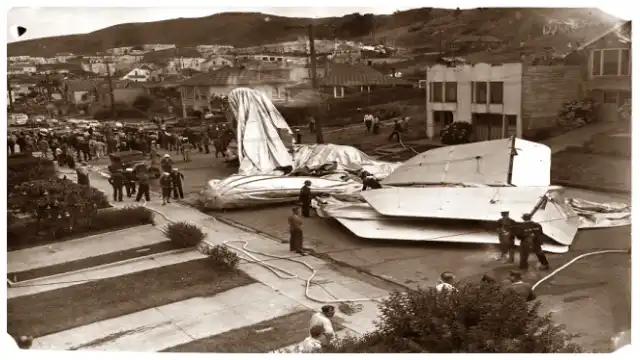
The airship slipped from their grip, caught a thermal gust, and bounced over the coastal cliffs. And it scraped the bluffs, the starboard propeller bent and one 325-pound depth charge broke loose, tumbling safely onto the Olympic Club golf course.
Freed of that deadweight, the blimp vaulted back into the sky. Automatic pressure valves opened, bleeding helium so rapidly that the envelope buckled into a limp, sagging “V” shape.
The dying airship drifted across the Crocker-Amazon neighborhood before finally settling onto the pavement outside 419 Bellevue Avenue in Daly City.
Police officers and neighborhood residents swarmed the control car, expecting to pull bloody crewmen from the wreckage. Instead, the scene inside presented a maddening puzzle:
- Operational Systems: The radio was intact, switched on, and dialed to the primary military channel. The engines had four hours of fuel remaining.
- Safety Gear: All three parachutes hung untouched in their storage racks. The yellow life raft remained lashed securely inside the cabin.
- Cabin Door: The side door was latched wide open — a common practice when deploying smoke markers, but dangerous during flight.
- Missing Gear: The only items missing were the two life vests worn by Cody and Adams, which regulations required them to wear throughout every over-water mission.
- Classified Files: The briefcase holding top-secret naval codes and patrol charts was sitting in plain sight, untouched.
If the men were in trouble, why didn’t they send an SOS over a radio that clearly worked?If they were forced to jump, why did they leave their parachutes and life raft behind?
Deconstructing the myths: Spies, UFOs, and Sensationalism
The sudden disappearance of two military officers on a sunny morning off San Francisco became fertile ground for wild rumors. Decades of sensationalist books and television shows lumped the L-8 blimp mystery in with alien abductions and Bermuda Triangle folklore.
When examined against hard military records, these sensational claims collapse completely.
The 1942 L-8 Mystery Theories
| Category | Theories |
|---|---|
| Sensational & Folklore | Captured by Japanese submarine; elaborate defection / spies; stowaway / fistfight in cabin; UFO / paranormal abduction |
| Aviation & Physical | Accidental fall while marking; dual-man overboard attempt; aerodynamic surge & separation; rapid Pacific hypothermia |
| Outcome | Debunked by logs; supported by physics |
The japanese capture theory
Rumors claimed a surfaced Imperial Japanese Navy submarine captured Cody and Adams. This idea fails on multiple fronts. Japanese submarines in 1942 carried deck guns and machine guns, but dragging two grown men out of a hovering blimp without firing a single shot, damaging the gondola, or leaving blood is physically impossible.
Furthermore, exhaustive post-war reviews of Imperial Japanese Navy logs showed no submarine claimed any engagement near the Farallons that morning.
The stowaway and mutiny theory
Another myth suggested a romantic rival or enemy saboteur hid aboard the craft, attacked the crew, and leaped clear. The physical layout of an L-class blimp destroys this narrative.
The gondola was a tiny aluminum box roughly the size of a minivan. There were no hidden compartments, crawlspaces, or false panels. With three men inspecting the airship before departure, hiding a fourth person was out of the question.
Paranormal abductions
Writers in the 1960s and 70s repurposed the L-8 disappearance into UFO literature, citing the “instantaneous” vanishing of the crew. But the aircraft did not vanish in a flash — it drifted for hours across open water and residential neighborhoods before coming down. Treating standard ocean drift as supernatural intervention ignores every law of physics and naval navigation.
What the physical evidence actually supports
Stripping away folklore leaves a straightforward aviation tragedy governed by aerodynamics, equipment quirks, and human reaction.
| Step | Event | Detail |
|---|---|---|
| 1 | Low-altitude hover (~30 ft) | Investigating oil slick |
| 2 | Door latched open | Deploying smoke floats |
| 3 | First airman slips and falls | Grease / wet step / sudden gust |
| 4 | Second airman lunges to assist | Torn from door frame / overboard |
| 5 | Weight loss surge (-350+ lbs) | L-8 climbs rapidly into clouds |
| 6 | Ghost drift to Daly City | Helium vents, crashes empty |
The dual-overboard sequence
The official US Navy Board of Investigation concluded that the pilots most likely suffered a catastrophic double fall while inspecting the oil slick.
Deploying a Mark IV smoke float required an airman to open the side door, lean out past the slipstream, and toss the canister by hand. The metal threshold was narrow and easily slickened by coastal fog.
If one officer lost his footing and tumbled out, the natural human reaction of his partner would be to lunge forward to grab him. Leaning out of an unpressurized cabin moving above rolling swells, the second pilot could easily be pulled over the side.
The immediate ascent effect
Airships rely on delicate buoyancy. The sudden loss of two adult men — roughly 350 to 400 pounds — would instantly cause the blimp to become aerostatically light.
Without hands on the elevator wheel, L-8 would have pitched up and climbed thousands of feet into the overcast within seconds. Even if the men hit the water alive, their airship was gone, ascending out of reach before they could swim back to it.
The brutal reality of pacific hypothermia
Why weren’t their bodies found during the massive search?
Water temperatures around the Farallon Islands hover between 10°C to 12°C (50°F to 54°F). In water that cold:
- Muscle control fails within 10 to 20 minutes.
- Hypothermia sets in rapidly, leading to unconsciousness.
- Heavy rip currents and apex predators — particularly the Farallon Islands’ dense population of Great White sharks — routinely pull submerged objects out into deep oceanic trenches.
The Navy and Coast Guard spent three days scouring 1,000 square miles of open sea. They found smoke markers and slicks, but the ocean had swallowed Cody and Adams.
The afterlife of the “Ghost Blimp”
While Cody and Adams were declared legally dead in 1943, the aircraft itself had a remarkably long life.
The Navy repaired the envelope, straightened the gondola, and sent L-8 right back into frontline anti-submarine duty for the rest of World War II. After the war, Goodyear bought the airship back from the government.
Renamed the America, the blimp spent the next several decades flying over Super Bowls, parades, and major sporting events across the nation.
The restored control car of the L-8 is preserved today at the National Naval Aviation Museum in Pensacola, Florida — a quiet memorial to two pilots lost on a foggy wartime morning.
Lieutenant Ernest Cody and Ensign Charles Adams did not vanish into a vortex or run away to start new lives. They were dedicated naval aviators who died on active duty, victims of an unforgiving ocean and a routine patrol that went disastrously wrong in the opening months of World War II.

