
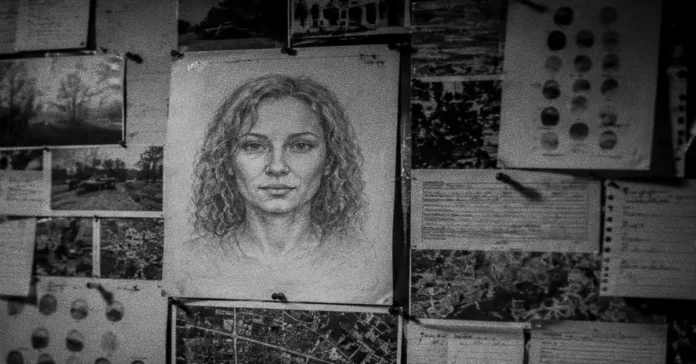
When a nameless woman died in a central Illinois nursing home in 1978, the state prepared to sweep her memory into a forgotten grave. A curious young reporter refused to close the file, pulling on a thread that unraveled half a century of bureaucratic secrecy. His investigation exposed the heartbreaking fate of a young schoolteacher who vanished in 1926 and spent fifty years hidden in plain sight.
The obituary that refused to stay silent
On March 2, 1978, staff at the Queenwood East nursing home in Morton, Illinois, logged the death of an elderly, blind patient. She had suffered a fatal heart attack. The undertaker cremated her remains, placed the ashes into a plain metal container, and submitted a routine death notice to the local paper.
The name on her chart was Mary Doefour.
That wasn’t a real family name. Decades earlier, state clerks created a cold, bureaucratic label: Jane Doe Number Four. Over the years, medical staff slurred the words together into “Mary Doefour.” She had no birth certificate, no known hometown, and not a single visiting relative.
The routine obituary landed on the desk of Rick Baker, a young reporter for Bloomington’s The Pantagraph. Most journalists would have run the few lines and moved on. Baker could not shake the horror of it. How does an American citizen live for half a century under state supervision without anyone knowing who she is?
He started asking questions. Those questions soon turned into an obsessive investigation that produced his book, Mary, Me: In Search of a Lost Lifetime.
The disappearance of myrle sizer
To understand how Mary ended up forgotten, we have to roll the clock back to the autumn of 1926 in Lisbon, Iowa.
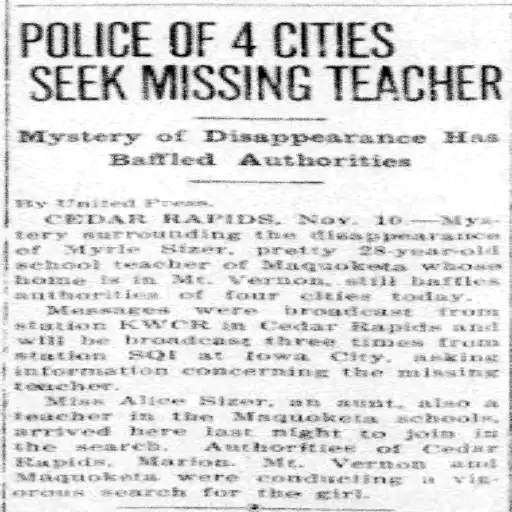
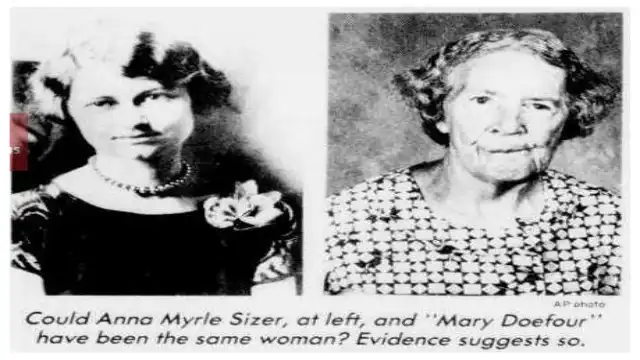
Anna Myrle Sizer known to friends and family simply as Myrle — was a vibrant, 26-year-old elementary school teacher. She was articulate, well-read, and universally liked. She had bright blue eyes, wavy light-brown hair, and high cheekbones.
In late October 1926, Myrle vanished.
She told her family she was heading to Cedar Rapids to see a doctor because she had been feeling unwell. She never returned home. Her sudden disappearance sent shockwaves through the community:
- The Rumors: Gossip quickly spread that Myrle was pregnant out of wedlock, a devastating social scandal for an unmarried schoolteacher in the 1920s.
- The Sightings: Motorists along Lincoln Highway (U.S. Route 30) reported seeing a young, distressed woman matching Myrle’s description wandering eastbound toward the Illinois state line.
- The Dead End: Search parties combed rural ditches and rivers. Her family hired private investigators. Anonymous threatening phone calls warned searchers to stop digging, and the trail eventually went cold.
Her family grieved, concluded she had been murdered, and gradually tried to move on with their lives.
Erased behind asylum walls
Around the same time Myrle vanished in Iowa, police in northern Illinois picked up a disoriented young woman wandering down a rural road.
She was physically battered, terrified, and clearly pregnant. Her memory was shattered by severe trauma. When authorities questioned her, she could not give them a name or an address. She only remembered fragments of a past life: she recalled standing in front of blackboards and teaching small children in a classroom.
Instead of receiving compassionate rehabilitation, she entered the meat-grinder of the early 20th-century asylum system.
Clerks stamped her as “Mary Doe #4” and sent her deep into the institutional network. She spent roughly thirty years at Peoria State Hospital in Bartonville, followed by stretches in high-security psychiatric wards.
Her stay at Bartonville represents one of the most tragic asylum cases of the era:

- Understaffing: At peak overcrowding, single nurses oversaw up to 150 patients at a time.
- Aggressive “Treatments”: Whenever Mary grew agitated or demanded to know where her family was, doctors ordered electroconvulsive shock therapy (ECT) and heavy sedatives.
- Memory Destruction: Decades of repeated electroshock didn’t heal her trauma; it destroyed her cognitive reserves, wiping away the faint memories she had left.
- The Lost Child: Hospital records indicated she gave birth shortly after entering the system, but the infant was promptly taken away and adopted out or placed into state care. No paper trail was ever shared with her.
She became quiet, docile, and blind in her final years, shuffled from one nursing home to another until her heart gave out in Morton.
Baker’s breakthrough
When Rick Baker began digging into forgotten asylum stories from the 1920s, missing-persons records from surrounding Midwestern states started aligning with eerie precision.
The physical profiles were nearly identical:
| Physical & Personal Markers | Missing Teacher Anna Myrle Sizer (1926) | Patient “Mary Doefour” (Illinois Records) |
| Height & Build | ~5 ft 4 in, slender | ~5 ft 4 in, slender frame |
| Facial Features | High cheekbones, round chin, blue eyes | High cheekbones, round chin, blue eyes |
| Hair | Naturally wavy, light brown | Naturally wavy, light brown |
| Vocation / Skills | Elementary school teacher; literate | Recalled teaching young kids; highly articulate early on |
| Timeline & Route | Vanished heading East on Route 30 (Fall 1926) | Found dazed on Northern Illinois road (c. 1926–1927) |
| Circumstance | Rumored early pregnancy | Heavily pregnant upon discovery; infant removed |
Baker tracked down old photographs of Myrle Sizer and compared them with early intake photos of Mary Doefour. Retired acquaintances and facial analysis confirmed an unmistakable likeness.
He had cracked the case. The missing teacher Anna Myrle Sizer and the nameless patient Mary Doefour were almost certainly the exact same woman.
The agony of denial
Armed with compelling evidence, Baker traveled to Iowa to deliver the truth to Myrle’s surviving brother, Harry Sizer. He expected relief. What he encountered instead was a brick wall of grief and protective denial.
Why did the family refuse to accept the findings?
- Unbearable Guilt: Accepting that Mary was Myrle meant acknowledging that she had not died quickly in 1926. It meant she had lived for fifty agonizing years in abusive state wards, just a three-hour drive away, while her family lived normal lives.
- Social Stigma: In the late 1970s, older generations still felt immense shame around out-of-wedlock pregnancy and psychiatric confinement.
- Legal Red Tape: Illinois state confidentiality laws sealed early medical intake records. Only an immediate next of kin had the legal standing to sue the state and unseal the files to confirm her fingerprints and dental records.
Harry Sizer, elderly and in failing health, refused to sign the petitions. “My sister died fifty years ago,” he told Baker. Just a few months after Baker published his findings, Harry passed away, taking the legal key to Mary’s records with him.
A haunting legacy in forgotten women’s history
Mary Doefour’s urn was eventually buried, but her story remains an indelible chapter in forgotten women history.
Her life reflects a double tragedy. First, an individual failed by social stigmas that drove a vulnerable woman onto the road. Second, a catastrophic systemic failure where state institutions stripped patients of their identity, chemically erased their minds, and locked them away from society.
Did Rick Baker give Mary her legal name back before the courts? No. But through diligent reporting, he gave her humanity back to the world. She was never just “Doe Number Four.” She was an educator, a sister, and a human being who deserved to be remembered.
How 1920s asylums handled unidentified patients
Early 20th-century state psychiatric hospitals treated unidentified admissions as custodial cases rather than active missing-persons investigations. Once local law enforcement dropped a disoriented person off at an asylum door, the priority was institutional intake, not detective work.
1. The Intake Ledger & Placeholder Naming
When a patient arrived without identification or the ability to speak coherently, the admissions clerk assigned a standardized placeholder:
- Sequential Numbering: Labels like Jane Doe No. 4 or John Doe #12 were logged in the institutional ledger alongside physical traits (apparent age, height, scars, eye color, and missing teeth).
- Phonetic Guesswork: If a patient muttered a single recognizable syllable or location, clerks often drafted an arbitrary working name (e.g., calling a patient “Mary Boston” because she repeated the word Boston).
- Personal Belongings: Clothing, jewelry, and personal items were cataloged and stored in a basement trunk, rarely cross-referenced against regional missing-persons bulletins.
2. Fragmented Communication Networks
Without centralized federal databases, identification relied on rudimentary local outreach:
- Newspaper Blurbs: An asylum superintendent might place a 2-line notice in a local county paper describing a “wandering female.” If the person came from two counties over — or across state lines — the notice went completely unseen.
- Jurisdictional Walls: Asylums operated as state-funded silos. Unless a desperate family independently hired a private investigator who physically traveled to regional wards to inspect intake books, cross-state matching was virtually nonexistent.
- Law Enforcement vs. Medical Isolation: Police departments rarely tracked long-term psychiatric commitments, viewing hospital placement as a resolved case of public vagrancy.
3. Institutional Drift & Identity Erasure
After 30 days without an inquiry, active attempts to identify a patient effectively stopped. Overcrowded wards meant doctors and attendants managed hundreds of beds at once. The placeholder name became the patient’s permanent identity on meal tickets, medical charts, and ward rosters.
Aggressive early therapies — heavy sedatives, chemical restraints, and later, electroconvulsive shock — often eroded whatever fractured memories the patient retained.
4. The Final Marker
If a Jane Doe died without being claimed, the state buried her in an institutional potter’s field. Graves were typically marked only with concrete posts stamped with their institutional ledger number, permanently sealing their real identity beneath the turf.

