

When you think of an Egyptian “ghost,” you’re probably picturing a mummy, bandages trailing, lurching through a dusty tomb. That’s Hollywood. The real ancient Egyptian concept of a ghost is infinitely weirder, more complex, and frankly, more terrifying.
It wasn’t about a single “soul.” It was about a spiritual crew.
The Egyptians didn’t believe in one spirit. They saw a person as a collection of different parts. If you died? The goal wasn’t just to “go to heaven.” The goal was to reassemble all your spiritual bits and pieces in the correct order to become a glorified, effective being.
And if you failed? If one of those pieces got lost, starved, or angry? That’s when you got a ghost.
This entire process, this desperate scramble for eternity, hinged on two of the most critical components: the Ka and the Ba. Understanding them is the key to understanding everything from mummies to pyramids to the Book of the Dead.
So, let’s dig in. What are these things, and why did they matter so damn much?
What Even Is a Soul in Ancient Egypt? (Hint: It’s Complicated)
First, ditch the modern idea of a single, invisible “soul.” An ancient Egyptian person was a composite, a bit like a high-tech spiritual machine. To be a complete human, you needed all your parts.
While there were many components, the most important ones were:
- The Khat: The physical body.
- The Ka: The life-force, or spiritual twin.
- The Ba: The personality, or individual self.
- The Ib: The heart, the seat of morality and thought.
- The Ren: Your name, your identity.
- The Sheut: Your shadow.
- The Akh: The ultimate goal. The transfigured, “glorified” spirit that lived with the gods.
For this discussion, we’re zoning in on the “big two,” the Ka and the Ba. They were the engine and the driver of the afterlife.
The Ka: Your Ethereal Twin & Life-Force
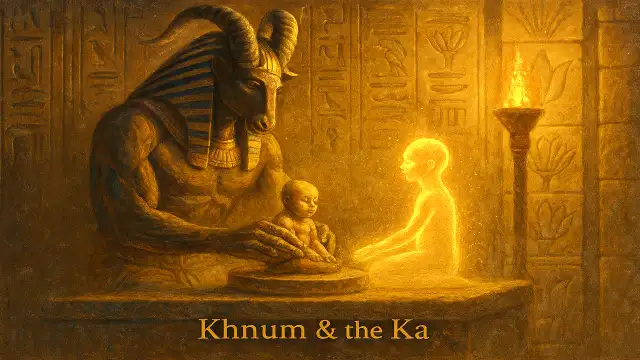
The Ka is one of the trickiest concepts, but it’s the most fundamental.
What is the Ka?
The Ka was your vital essence. It was your “life-force,” an invisible, spiritual double born at the exact same moment you were. The god Khnum was often depicted crafting both the physical body and the Ka of a child on his potter’s wheel.

Think of it this way: The Ka is the battery. It’s the divine spark of life that animates the Khat (the body).
- While you were alive, your Ka was with you.
- When you died, your Ka “left” your body… but it didn’t go far.
This is the entire reason for tombs, mummies, and offerings.
Why Mummies and Tombs Were Ka-Apartments
The Ka was the part of you that still needed to live in the world of the dead. It was anchored to your physical form. But here’s the catch: the Ka still got hungry.
This is not a metaphor. The Egyptians believed the Ka literally needed to eat and drink.
This is why tombs were filled with supplies. The endless paintings of bread, beer, oxen, and geese on tomb walls weren’t just “nice decorations.” They were a magical menu. Priests performed a ritual called the peret-kheru or “voice-offering,” which, combined with the images, would spiritually manifest the food for the Ka to consume.
What happened if the Ka starved? It would cease to exist. Eternity, gone.
But the Ka also needed a home. The tomb was its permanent residence. And it needed a vessel to anchor to. This was the mummy’s primary job. The preserved body was a permanent, recognizable home base for the Ka.
The Backup Plan: What if the mummy was destroyed by tomb robbers? Or decayed? The Egyptians, brilliant engineers that they were, had a backup system: Ka-statues. These were statues of the deceased, often hidden in the tomb, that the Ka could inhabit if its body was… unavailable.
The Ba: Your Personality on Wings

If the Ka was the battery, the Ba was the software.
What is the Ba?
The Ba is what made you, you. It was your unique personality, your consciousness, your character, your mind—everything that made you an individual and not just another body.
While the Ka was static and bound to the tomb, the Ba was mobile.
This is why the Ba is almost always depicted in hieroglyphs and art as a human-headed bird. The human head represented your unique face and personality. The bird body represented its freedom to fly.

The Ba’s Daily Commute
The Ba had an incredibly important job.
According to texts like the Book of the Dead, the Ba could leave the tomb during the day. It could fly out into the world, sit in its favorite garden, visit its old home, or travel with the sun god Ra on his boat through the sky. It was the part of you that could still enjoy being “alive.”
But every single night, the Ba had a critical task: It had to return to the tomb and reunite with the Ka.
Why? Because this nightly reunion was essential for survival. The Ba (personality) would “recharge” from the Ka (life-force), which was safely housed in the Khat (the mummy).
This union was the key to regeneration. It was, in effect, a nightly dress rehearsal for resurrection. Without this reunion, the Ba would be lost, and the whole plan for eternity would fall apart.
Ka vs. Ba: A Quick Breakdown
This gets confusing, so here’s the simple cheat sheet:
| Feature | The KA (Your Double) | The BA (Your Personality) |
| What is it? | Your “life-force” or spiritual battery. | Your “personality” or individual consciousness. |
| Depiction? | Two outstretched arms (hieroglyph) or a double of you. | A human-headed bird. |
| Mobility? | Static. Bound to the tomb and the body/statue. | Mobile. Could fly between the tomb and the outside world. |
| Needs? | Sustenance. It needed food and drink offerings. | Reunion. It needed to return to the Ka and body every night. |
| Analogy? | The Anchor or the Battery. | The Bird or the Software. |
So, Where Do “Ghosts” Come In?
Alright, now we get to the “ghosts.”
The ultimate goal after death wasn’t to be a Ka or a Ba. The goal was to pass the final judgment—the “Weighing of the Heart.” Your Ib (heart) would be weighed against the feather of Ma’at (truth).
- If your heart was light (you lived a good life), your Ka and Ba would successfully and permanently merge. You would then “transfigure” into an Akh—a “glorified, effective spirit” (Source: British Museum). The Akh was a divine being, living with the gods, powerful and eternal. This was success.
But what if things went wrong?
This is precisely where the Egyptian “ghost” comes from. A ghost (called a mut) was a soul that had failed. It was a restless, angry, and often dangerous spirit.
This failure could happen in several ways:
- A Starving Ka: The family of the deceased stopped bringing offerings. The Ka became hungry, angry, and trapped.
- A Lost Ba: The mummy was destroyed, and the tomb was desecrated. The Ba returned at night but couldn’t find its body or its Ka. It was locked out, becoming a homeless, wandering spirit.
- A Failed Judgment: The person was wicked in life. Their heart was heavy, and it was devoured by the demon Ammit. Their soul was cast into “the second death”—total non-existence.
- A Violent or Improper Death: Someone who died without proper burial rites couldn’t even begin the journey.
These restless spirits were the real “ghosts” of ancient Egypt. And they were not friendly.
Letters to the Dead
We know this because of an incredible archaeological find: “Letters to the Dead.”
These were letters, often written on pottery bowls filled with offerings, from living people… to their dead relatives. And they weren’t just saying “hi.” They were complaining.
As scholars at institutions like Archaeology Magazine report, the living would write to a restless Akh or Ba, blaming it for problems: “Why are you making my wife sick?” or “Stop interfering with my new marriage!” or “What did I do to you? Please stop haunting me.”
In one famous story, a priest named Khonsemhab is haunted by the ghost of a man named Nebusemekh. The ghost isn’t evil—he’s miserable. Why? Because his tomb had fallen into ruin, and his Ka had nowhere to live and nothing to eat. He was a restless spirit, and his only recourse was to haunt the living until someone fixed his tomb.
This is the Egyptian ghost: not a monster, but a “failed” soul. A bureaucratic nightmare in the afterlife. It was a being whose Ka and Ba were out of sync, a spirit who was a victim of a broken system, and it was pissed.
Why This Matters (Even If You’re Not a Mummy)
So, why spend all this time on dusty beliefs?
Because this complex system of the Ka and Ba isn’t just trivia. It is the “why” behind the most recognizable symbols of human history.
- Why build pyramids? To create an indestructible “mansion” for the pharaoh‘s Ka.
- Why mummify? To create a permanent, recognizable “anchor” for the Ba to return to.
- Why write the Book of the Dead? It was an instruction manual. It was a collection of spells to help the Ba navigate the underworld, reunite with the Ka, and pass the final judgment to become an Akh.
- Why carve names everywhere? Because your Ren (name) was a part of your soul. To have your name spoken and read was to keep you existing. This is why pharaohs would chisel out the names of their predecessors—it was an attempt to kill them in the afterlife.
This wasn’t superstition. To the ancient Egyptians, this was spiritual engineering. It was a practical, logical system designed to do one thing: defeat death.
They were some of the first people in history to so profoundly dissect the human consciousness—separating our life-force (Ka) from our personality (Ba) from our moral compass (Ib). They created an entire blueprint for eternity.
And in their restless spirits, their hungry Ka and their lost Ba, they gave us a powerful and much more relatable vision of a “ghost”: not a monster, but a soul that’s just trying to get home.
Your Turn
What part of the Egyptian soul fascinates you the most? The mobile Ba, the hungry Ka, or the idea that your heart (Ib) would be weighed for its sins?
Drop your thoughts in the comments below!

